
Have a Question?

Support at Home: A Complete Guide for Older Australians and Families
INS LifeGuard • August 21, 2026

Support at Home is the Australian Government's in-home aged care program, designed to help older Australians get the care and support they need to remain living safely and independently at home for longer.
The program replaced the former Home Care Packages Program and Short-Term Restorative Care Programme on 1 November 2025, bringing a range of in-home aged care services together under a new system.
Depending on your assessed needs, Support at Home can provide access to services ranging from nursing and allied health to personal care, transport, respite, cleaning, meals, assistive technology and home modifications.
But understanding what Support at Home covers, how much funding you may receive, what you may need to contribute and how to access services can be confusing.
This guide explains how Support at Home works, what's covered and what older Australians, families and carers need to know.
What is the Support at Home program?
The Support at Home program is an Australian Government aged care program that helps eligible older people access care and services while continuing to live in their own homes.
Rather than providing everyone with the same type or level of support, the program is designed around a person's assessed needs.
Depending on those needs, support may include:
- nursing and allied health care
- personal care and help with daily activities
- social support and community engagement
- respite care
- transport
- domestic assistance
- meal preparation and delivery
- home maintenance
- assistive technology
- home modifications.
Support at Home provides both ongoing care and several short-term pathways for particular needs.
Who is eligible for Support at Home?
Support at Home is designed for older Australians who need help to remain living safely and independently in their own home.
Being a certain age does not automatically mean you receive Support at Home funding. You first need to meet the aged care eligibility requirements and have an aged care assessment to determine whether you need government-funded support and which services are appropriate for you.
What age do you need to be for Support at Home?
You may be eligible for an aged care assessment if you are:
- 65 years or older, or
- 50 years or older for Aboriginal or Torres Strait Islander people,
and you need assistance with everyday activities because of changes associated with ageing.
You may also be eligible from age 50, or 45 for Aboriginal or Torres Strait Islander people, if you are experiencing, or are at risk of, homelessness.
Eligibility isn't based on age alone. Your circumstances and the difficulties you are experiencing with everyday activities are also considered.
What kinds of needs could make me eligible?
You might consider applying for an assessment if changes in your health, mobility or ability to manage everyday activities mean you're finding it harder to live independently.
For example, you may need assistance with:
- showering, dressing or other personal care
- preparing meals
- cleaning and household tasks
- getting around your home or community
- transport
- managing health or clinical care needs
- maintaining social connections
- keeping your home safe and accessible
- equipment or home modifications that help you remain independent.
You don't need to work out which Support at Home services or funding classification you need before applying. The aged care assessment identifies your needs and determines what support may be appropriate.
How is eligibility assessed?
The first step is generally to contact My Aged Care and complete an initial eligibility check.
If you appear eligible for government-funded aged care, My Aged Care can arrange an assessment.
An assessor will look at your circumstances, including your health, mobility, ability to carry out everyday activities, support already available to you and areas where you may need assistance.
The assessment isn't simply about identifying what you can no longer do. It's also about understanding what matters to you and what support could help you maintain your independence, safety and quality of life at home.
Following your assessment, you'll receive an outcome explaining the aged care services you've been approved to access.
If you're approved for ongoing Support at Home, you'll also be assigned a Support at Home funding classification based on your assessed needs.
Do I need to have a serious medical condition to qualify?
Not necessarily.
Support at Home isn't limited to people with a particular diagnosis or medical condition. The key question is whether age-related changes affect your ability to manage everyday life independently and whether you have an assessed need for aged care support.
Someone may need relatively modest assistance with everyday tasks, while another person may require personal care, nursing, allied health and other services.
That's one reason Support at Home has eight ongoing funding classifications; support can be matched more closely to different levels of assessed need.
What if I'm not sure whether I'm eligible?
You don't need to decide that yourself.
My Aged Care provides an online eligibility checker, or you can contact My Aged Care to discuss your circumstances.
If you're helping a parent, partner or another older person, you can also help them start the process.
What services are covered by Support at Home?
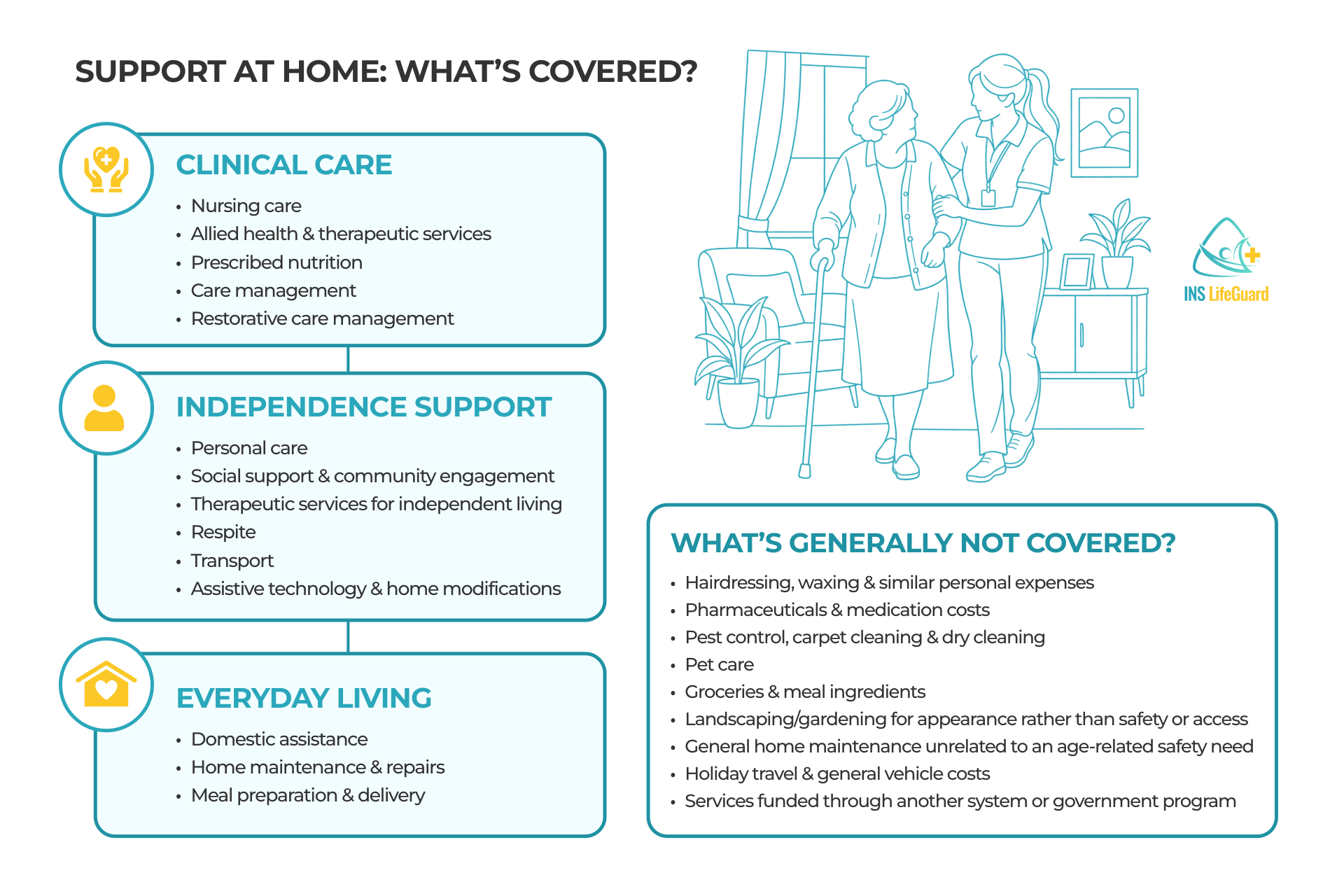
Support at Home services can broadly be understood across three areas:
- Clinical Care, including health and clinical services such as nursing and allied health
- Independence Support, including personal care, mobility, social connection and other services that support independent living
- Everyday Living, including practical assistance with household tasks, home maintenance and meals.
In the Australian Government's formal Support at Home Service List, the contribution categories are called Clinical Supports, Independence and Everyday Living. Consumer information may use terms such as Clinical Care and Independence Support to make the types of support easier to understand.
Clinical Care
Clinical Care provides specialised health and clinical services to help you maintain or regain your health, functional ability and independence.
Depending on your assessed needs, Clinical Care can include:
- Nursing care – including services provided by Registered Nurses and Enrolled Nurses
- Allied health and therapeutic services – including physiotherapy, occupational therapy, podiatry, dietetics, speech pathology, psychology and other approved allied health services
- Prescribed nutrition – where specialised nutritional products are prescribed by an appropriate health professional
- Care management – coordinating and overseeing your Support at Home services and care
- Restorative care management – additional care management when receiving services through the Restorative Care Pathway
Nursing care can include clinical assessment and monitoring, wound care, medication management, continence management, treatment and education to help you manage your health at home.
Clinical services are an important part of Support at Home because they can help older Australians manage health conditions and receive appropriate care without necessarily leaving home.
Independence Support
Independence Support helps you manage everyday activities, maintain your abilities, and stay connected to your community.
Depending on your assessment and approved Support Plan, services can include:
Personal care
Personal care provides assistance with self-care and activities of daily living.
This may include help with:
- showering and bathing
- dressing
- eating
- personal hygiene
- mobility
- non-clinical continence management
- self-administration of medication.
Personal care can make a significant difference when everyday activities become more difficult, helping older people maintain their dignity, routines and independence at home.
From 1 October 2026, eligible Support at Home participants with available funding will have no participant contribution for approved personal care.
Social support and community engagement
Support can help you remain socially connected and continue participating in your community.
This can include individual or group social support, accompanied activities, cultural support, assistance attending appointments and help using digital technology where it supports your independence and participation.

Therapeutic services for independent living
These services help you maintain or regain the skills needed to manage everyday life.
They can include services such as Aboriginal and Torres Strait Islander health practitioners, counselling or psychotherapy, and other approved therapeutic supports.
Respite
Respite provides temporary support when your usual family member or informal carer is unavailable or needs a break.
Depending on your needs, respite may be provided in your home or through community-based support.
Transport
Transport assistance can help you get to appointments, activities and other places you need to go to maintain your independence and community connections.
This can include direct transport with a driver or indirect transport assistance such as approved taxi or rideshare vouchers.
Assistive technology and home modifications
Assistive technology and home modifications can help make everyday activities easier and your home safer and more accessible.
This can include approved equipment, products and changes to the home that address an assessed age-related need.
The Assistive Technology and Home Modifications Scheme (AT-HM) supports these items.
Want to know what equipment and home modifications can be funded?
Read our complete AT-HM funding and inclusions guide →
Everyday Living
Everyday Living services provide practical assistance with household activities that can become more difficult as we age.
The aim is to help keep your home safe and liveable while supporting you to continue living independently.
Domestic assistance
Domestic assistance can include essential household tasks such as:
- general house cleaning
- vacuuming and mopping
- washing dishes
- laundry and ironing
- making beds
- shopping assistance.
However, not every household service is covered. Services such as pest control, professional carpet cleaning and dry cleaning are generally outside the scope of Support at Home domestic assistance.
Pet care and the actual cost of groceries are also not covered.
Home maintenance and repairs
Support may be available for essential light gardening and minor maintenance that helps keep your home safe and accessible.
This can include things such as:
- lawn mowing
- pruning
- clearing pathways for safe access
- cleaning gutters
- replacing lightbulbs
- minor repairs such as fixing a broken door handle.
Landscaping or gardening purely for appearance is not generally covered, nor is general home maintenance unrelated to an assessed age-related safety or accessibility need.
Meal preparation and delivery
Support at Home can help you prepare meals at home or deliver prepared meals.
However, it does not cover the cost of food or ingredients. The funded component relates to the preparation and delivery service.
What isn't generally covered by Support at Home?
Support at Home funds aged care services that address needs related to ageing and help you remain independent at home. It doesn't cover every household or personal expense.
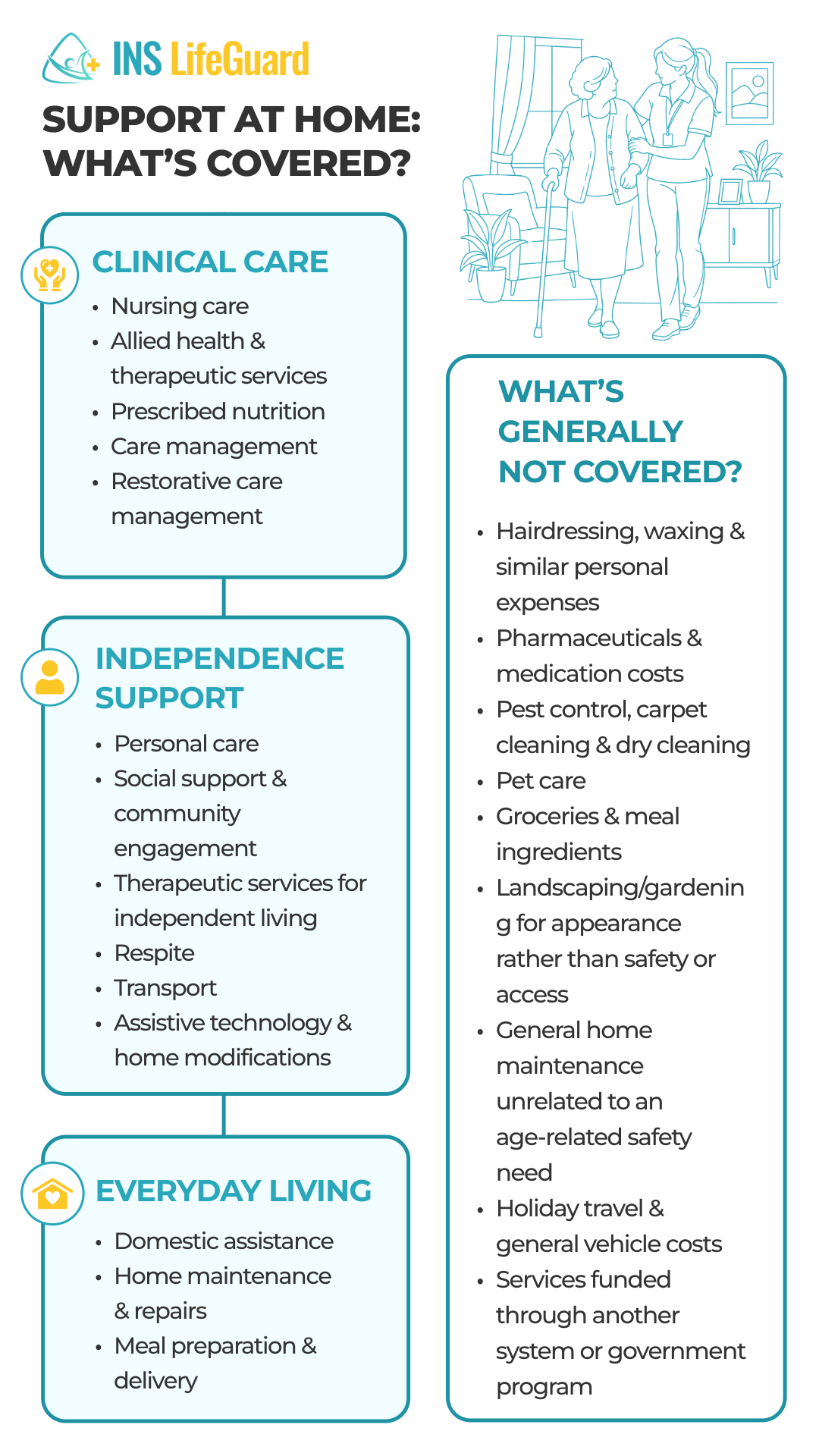
Depending on the service and your circumstances, things that are generally outside the scope of Support at Home include:
- hairdressing, waxing and similar personal expenses
- pharmaceuticals and medication costs
- pest control, carpet cleaning and dry cleaning
- pet care
- groceries and meal ingredients
- landscaping and gardening for appearance rather than safety or access
- major or general home maintenance that isn't related to an age-related safety need
- holiday travel and general vehicle costs
- services that should be funded through another government program or system.
What you can access depends on your aged care assessment, Support Plan, and approved funding, so check with your provider or My Aged Care if you're unsure whether a particular service is covered.
Does Support at Home cover assistive technology and home modifications?
Yes, where you are assessed as needing them.
The Assistive Technology and Home Modifications Scheme, commonly known as AT-HM, provides separate needs-based funding for approved equipment and home modifications.
Assistive technology can include equipment that helps an older person perform everyday activities more safely or independently.

Home modifications can address accessibility and safety needs within the home.
Funding is separate from your ongoing Support at Home budget and is generally provided at Low, Medium, or High funding tiers based on assessed need.
Learn more about Support at Home and Assistive Technology funding →
How Are Support at Home Classifications Assessed?
Your Support at Home funding classification is based on your assessed care needs.
An aged care assessment looks at your individual circumstances and the support you may need to continue living safely and independently at home.
This can include factors such as:
- your health and mobility
- how well you can manage everyday activities
- personal care needs
- clinical and health-related needs
- your ability to move safely around your home and community
- support already available from family, carers or others
- areas where additional assistance may help you maintain your independence.
If you are approved for ongoing Support at Home services, your assessment determines which of the eight ongoing funding classifications reflects your level of need.
Your funding classification is different from your participant contribution rate. Your classification determines the amount of government funding available for your approved ongoing care, while your participant contribution determines how much you may personally need to contribute towards particular services.
Read our complete guide to Support at Home costs and contributions →
How much funding can you receive under Support at Home?
If you're approved for ongoing Support at Home services, your aged care assessment will determine which of eight funding classifications best reflects your assessed care needs.
Each classification provides a quarterly budget you can use for approved services in your Support Plan. Higher classifications provide larger budgets for people assessed as needing greater ongoing support.
Current Support at Home funding classifications
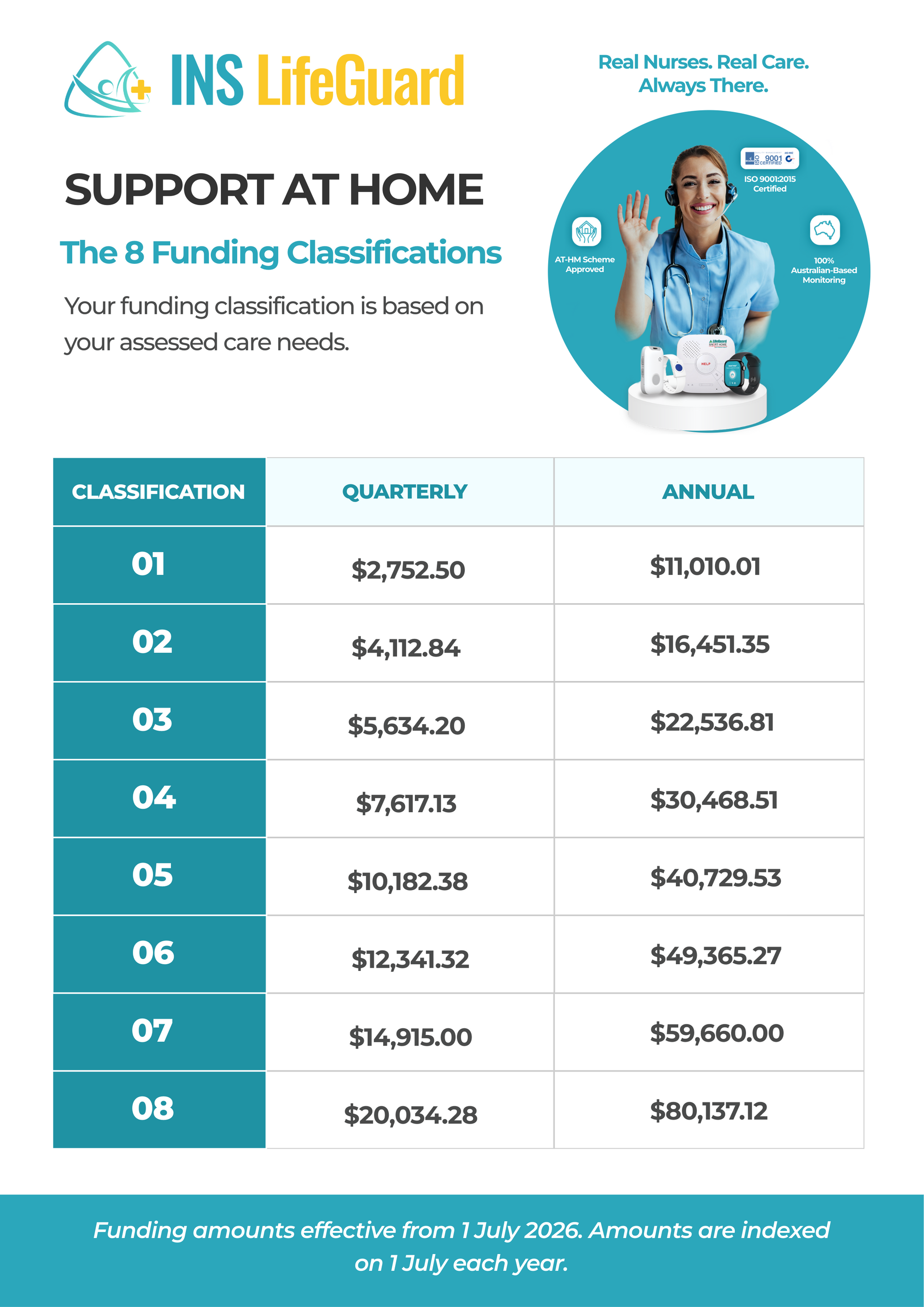
The following funding amounts are effective from 1 July 2026. Funding amounts are indexed on 1 July each year.
| Classification | Quarterly budget | Approx. annual amount |
|---|---|---|
| 1 | $2,752.50 | $11,010.01 |
| 2 | $4,112.84 | $16,451.35 |
| 3 | $5,634.20 | $22,536.81 |
| 4 | $7,617.13 | $30,468.51 |
| 5 | $10,182.38 | $40,729.53 |
| 6 | $12,341.32 | $49,365.27 |
| 7 | $14,915.00 | $59,660.00 |
| 8 | $20,034.28 | $80,137.12 |
The amounts shown above include the 10% allocation for care management.
Because funding amounts are indexed annually, this table should be checked against the latest Support at Home funding classifications on the Australian Government Department of Health, Disability and Ageing website.
How is your Support at Home budget provided?
Your ongoing Support at Home funding is allocated as a quarterly budget, rather than receiving the full annual amount at once.
If you don't use all of your budget during a quarter, you can generally carry over unspent funding up to $1,000 or 10% of your quarterly budget, whichever is greater, into the next quarter.
For participants receiving ongoing services, 10% of the quarterly budget is allocated to care management. Care management helps coordinate your care and services and ensures they continue to support your assessed needs.
If your care needs change significantly and your existing classification is no longer sufficient, you can be reassessed.
Are there other types of Support at Home funding?
Yes. The eight classifications above apply to ongoing Support at Home services.
There are also separate funding arrangements for particular short-term or specific needs, including:
- the Assistive Technology and Home Modifications (AT-HM) Scheme
- the Restorative Care Pathway
- the End-of-Life Pathway.
These operate separately from your ongoing quarterly Support at Home classification.
Learn more about Support at Home funding from the Australian Government
How much will you have to contribute towards Support at Home?
The Australian Government funds Support at Home services, but depending on the type of service you receive and your financial circumstances, you may also be asked to contribute towards the cost.
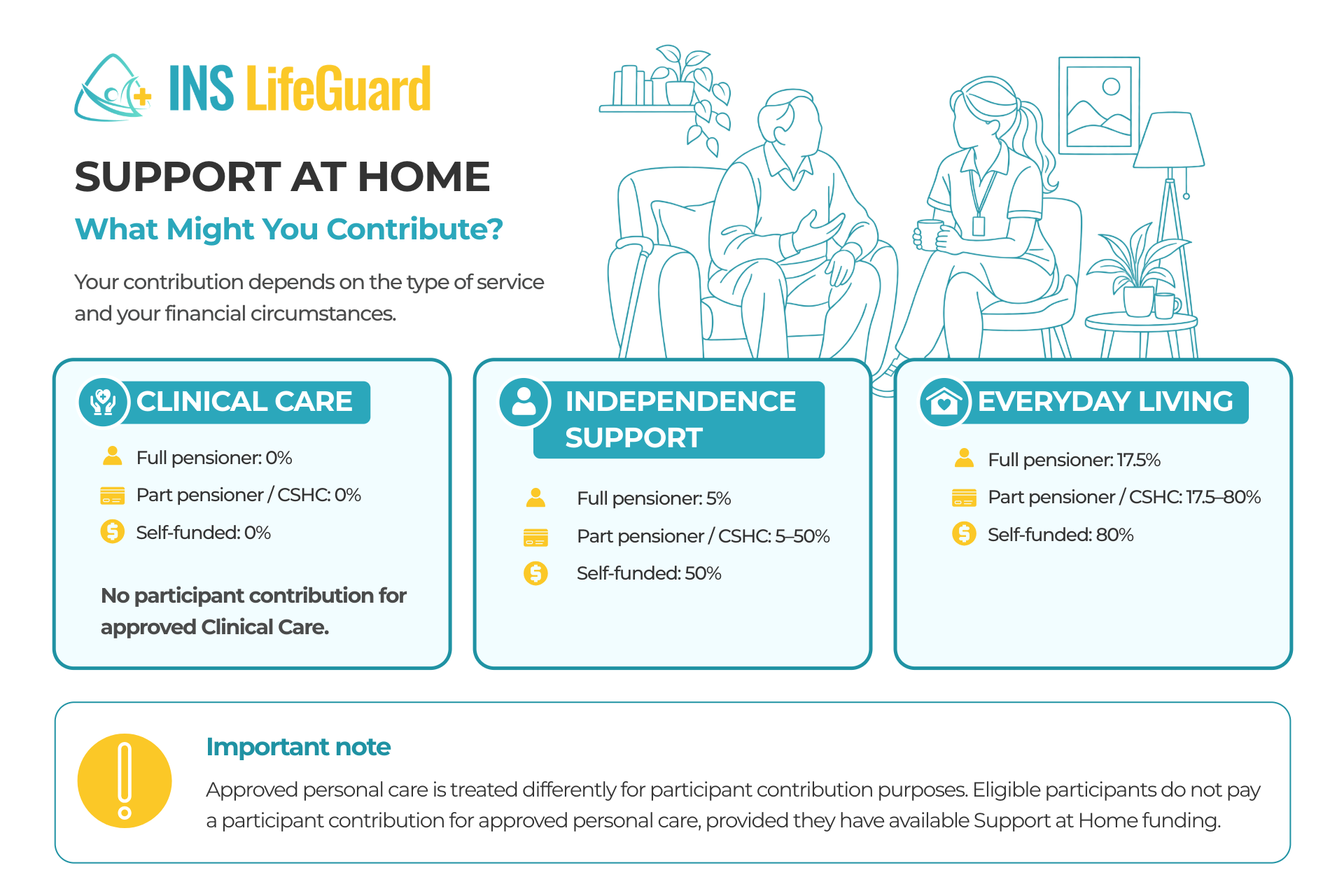
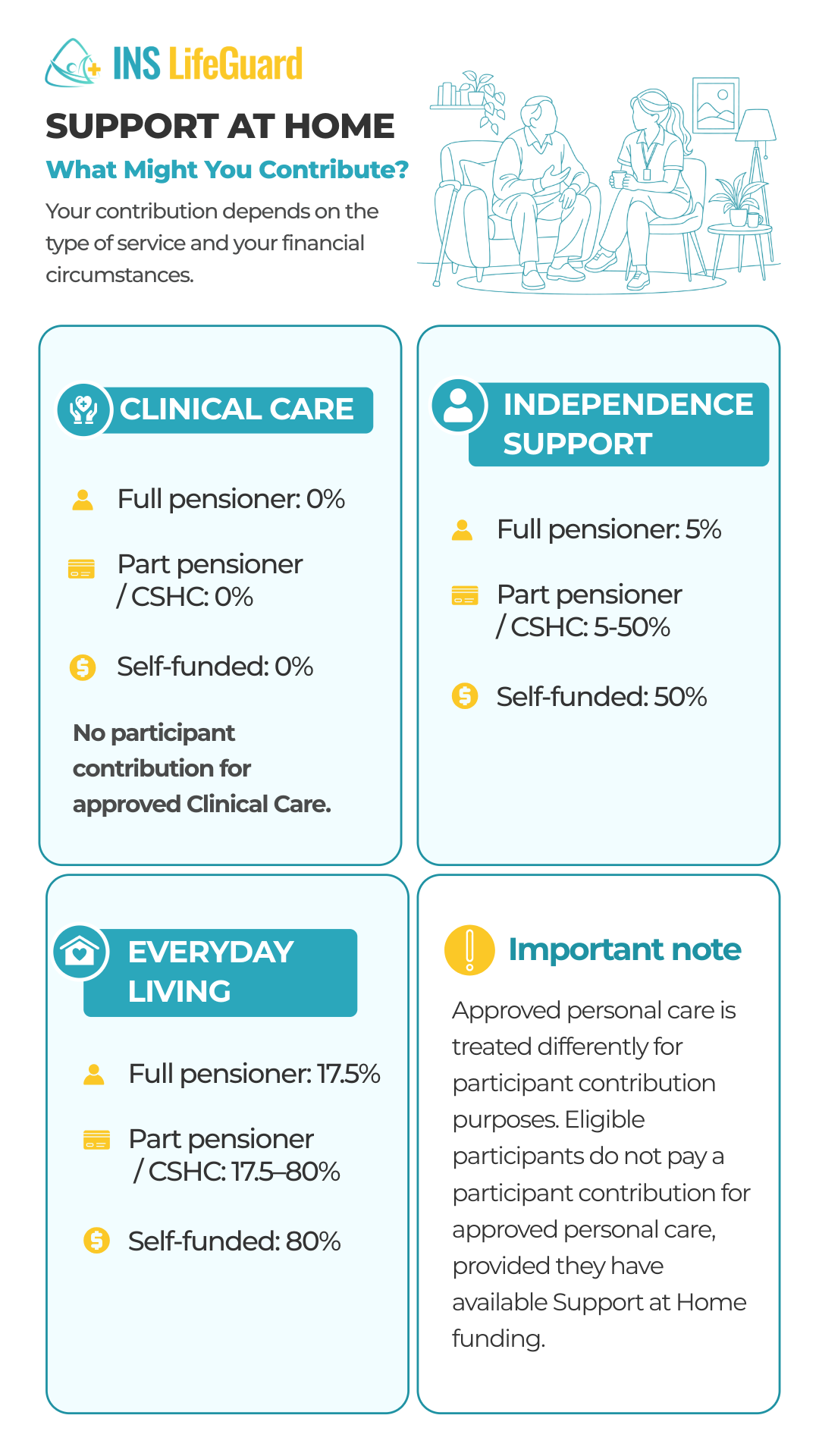
For people under the standard Support at Home contribution arrangements, services have different contribution rates depending on whether they fall within Clinical Supports, Independence or Everyday Living for contribution purposes.
For consistency with the consumer-friendly terminology used throughout this guide, we've referred to these below as Clinical Care, Independence Support and Everyday Living.
| Your circumstances | Clinical Care | Independence Support | Everyday Living |
|---|---|---|---|
| Full pensioner | 0% | 5% | 17.5% |
| Part pensioner or self-funded CSHC holder | 0% | 5–50% | 17.5–80% |
| Self-funded non-CSHC holder | 0% | 50% | 80% |
Personal alarms and monitoring technology may be eligible for funding through the Support at Home program where they meet the relevant requirements and form part of an older person's assessed support needs.
This can be particularly valuable for someone who lives alone, has experienced falls or wants the reassurance of being able to call for assistance while maintaining their independence.
Funding isn't automatic. Whether a personal alarm can be funded depends on the person's assessed needs, approved support and the applicable Support at Home requirements.
How to Get a Personal Alarm Funded Through Support at Home →

What other Support at Home pathways and funding are available?
Support at Home isn't limited to ongoing services provided through the eight funding classifications.
Separate pathways and funding arrangements also respond to particular needs, including short-term restorative care, end-of-life care, and assistive technology and home modifications.
These arrangements operate differently from your ongoing quarterly Support at Home budget.
Restorative Care Pathway
The Restorative Care Pathway provides time-limited, intensive support to help an older person maintain or improve their independence and ability to manage everyday activities.
It may be appropriate when there is an opportunity to improve or maintain a person's function through a coordinated program of services rather than simply providing ongoing assistance with tasks.
Depending on the person's assessed needs, restorative care may involve services such as nursing, allied health, personal care and other supports aimed at helping them achieve agreed goals.
The focus is on helping the person maintain or regain abilities wherever possible so they can continue living as independently as possible at home.
Access to the Restorative Care Pathway depends on assessment and eligibility, and its funding is separate from the eight ongoing Support at Home classifications.
End-of-Life Pathway
The End-of-Life Pathway provides additional support for eligible older people approaching the end of life who wish to remain at home.
It provides access to a higher level of care and services during this period without relying solely on the person's ongoing Support at Home budget.
Support can be tailored to the person's assessed needs and may work alongside care provided by family, health professionals and other services.
Eligibility for the End-of-Life Pathway is subject to specific assessment and clinical requirements, so families should speak with the person's healthcare team, Support at Home provider or My Aged Care about the support available.
Assistive Technology and Home Modifications Scheme
The Assistive Technology and Home Modifications Scheme, known as AT-HM, provides separate funding for approved equipment and home modifications that address an assessed age-related need.
Assistive technology can include products or equipment that help a person carry out everyday activities more safely or independently. Home modifications can help improve the safety, accessibility and usability of the home.
Funding is needs-based and is separate from the participant's ongoing quarterly Support at Home budget. This means eligible assistive technology and home modifications do not necessarily have to be paid for from the funding available for a person's regular ongoing services.
Access depends on assessment, the item or modification required, and the applicable Support at Home requirements.
Learn more about Support at Home and Assistive Technology funding →
Can you receive these supports alongside ongoing Support at Home services?
Depending on your circumstances and assessed needs, these pathways and funding arrangements can operate alongside ongoing Support at Home services.
They are designed for particular needs rather than replacing the eight ongoing funding classifications altogether.
Your aged care assessment and Support Plan help determine which services, pathways or additional funding may be appropriate for you. If your circumstances or care needs change, speak with your provider or My Aged Care about whether you need a further assessment.
How do I apply for Support at Home?
Access to government-funded aged care generally begins through My Aged Care.
The process broadly involves:
- Contacting My Aged Care to discuss your needs.
- Completing an aged care assessment to determine your eligibility and care needs.
- Receiving your assessment outcome, which explains the services and funding you have been approved for.
- If approved for ongoing Support at Home funding, receiving a priority category and entering the Support at Home Priority System.
- Once funding is allocated, choosing a registered Support at Home provider and agree on how your approved services will be delivered.
Your assessment matters because Support at Home funding and services are based on your individual needs, not simply a package you choose.
Is there a waiting list for Support at Home?
There can be a wait between being approved for ongoing Support at Home services and receiving your allocated funding.
The Support at Home Priority System determines when ongoing funding is allocated, based on a person's priority category and approval date.
Priority categories include urgent, high, medium and standard.
Wait times can change as funding and demand change, so it's best to check the latest information directly with My Aged Care rather than relying on an older estimate.
Some people may receive interim funding while waiting for their full allocation. Interim funding is currently 60% of the person's ongoing classification, allowing priority services to begin while the remaining funding is awaited.
Waiting for Support at Home? Read what older Australians and families can do while they wait →
Support at Home is ultimately about independence
The details of funding classifications, service categories and contribution rates can make aged care feel complicated.
But the purpose behind Support at Home is much simpler: helping older Australians receive appropriate support while continuing to live safely, confidently and independently at home.
For one person, that may mean help with cleaning and meals.
For another, it might include nursing, physiotherapy and personal care.
Someone else may benefit from transport, home modifications or assistive technology that makes everyday life safer.
And for older Australians who spend significant periods alone, knowing they can reach assistance quickly in an emergency can also be an important part of remaining independent.
Supporting safety at home with INS LifeGuard
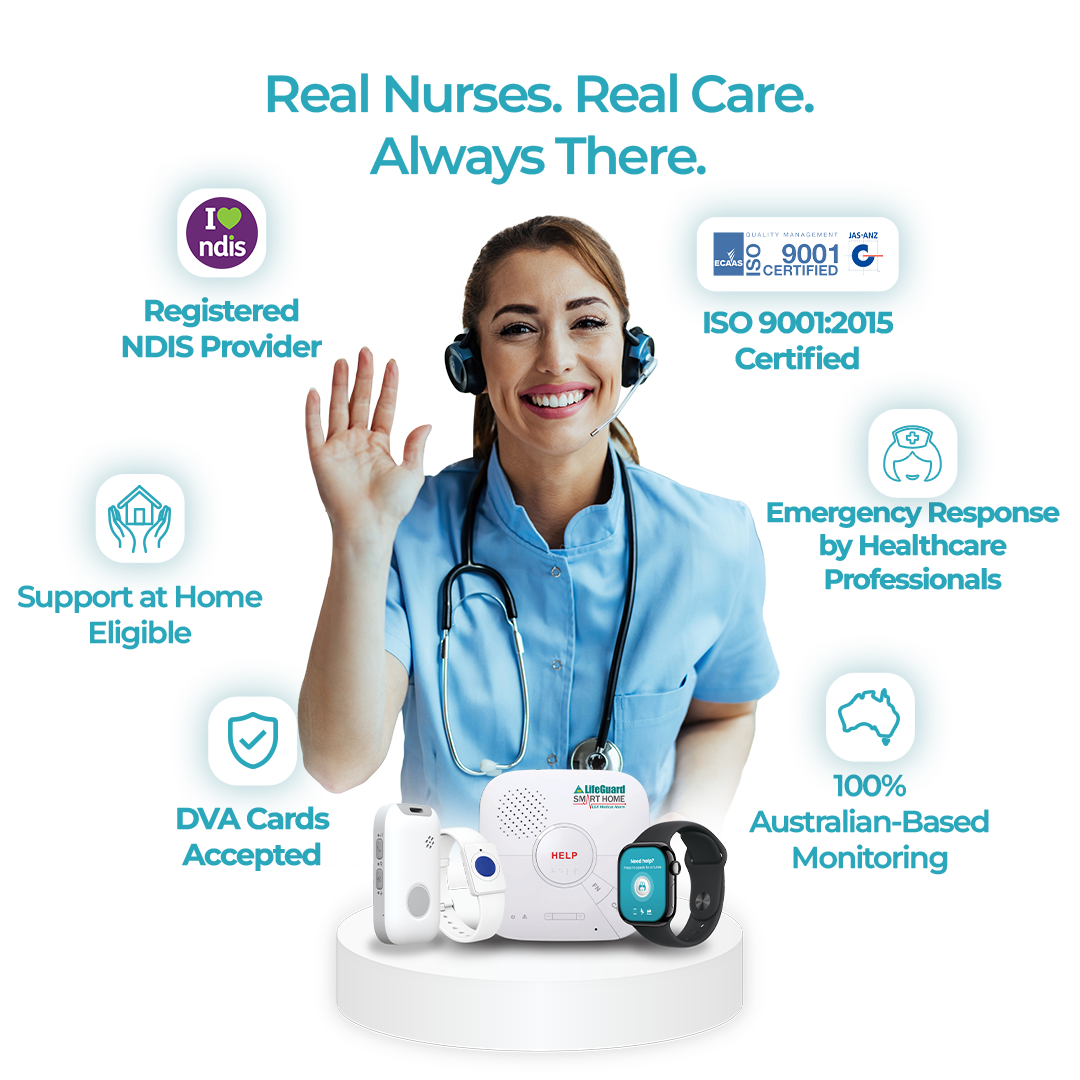
INS LifeGuard has been helping Australians maintain their independence with 24/7 monitored personal alarm services for home and away.
Unlike an unmonitored alarm that relies solely on contacting family or friends, an INS LifeGuard monitored personal alarm connects the user with our 24/7 Emergency Response Centre.
Our Clinical Operations Centre is staffed by trained emergency responders who are also qualified and experienced healthcare professionals, including Registered and Enrolled Nurses.
If an alarm is activated, our team can communicate with the client, assess what is happening and coordinate an appropriate response.
For older Australians and their families, a monitored personal alarm can provide another layer of support for independent living, whether the service is funded through Support at Home or arranged privately.
Support at Home: Frequently Asked Questions
What replaced Home Care Packages in Australia?
The Support at Home program replaced the Home Care Packages Program from 1 November 2025. It provides ongoing and short-term support to eligible older Australians living at home.
How many Support at Home funding levels are there?
There are eight ongoing Support at Home funding classifications. Your classification and available funding depend on your assessed care needs.
What can Support at Home pay for?
Depending on your assessment and approved services, Support at Home can fund services including nursing, allied health, personal care, social support, respite, transport, cleaning, meal preparation, home maintenance, assistive technology and home modifications.
Is personal care free under Support at Home?
Eligible participants do not pay a participant contribution for approved personal care services, provided they have available Support at Home funding. Personal care still uses funding from the participant's Support at Home budget.
Read our complete guide to Personal Care under Support at Home →
How much funding can I receive through Support at Home?
Support at Home has eight ongoing funding classifications. Each provides a quarterly budget based on assessed care needs. Funding amounts are indexed annually, so check the current classification amounts when planning services.
Do I have to pay for Support at Home services?
It depends on the service and your circumstances. Approved Clinical Supports have no participant contribution, while contributions can apply to Independence and Everyday Living services. Different arrangements can apply to people protected by transitional contribution rules.
Read our complete guide to Support at Home costs and contributions →
Where can I get official information about Support at Home?
For eligibility, assessments and information about your individual circumstances, visit My Aged Care or contact My Aged Care directly.
This article provides general information. Support at Home rules, funding amounts and contribution arrangements can change. Individual eligibility, services and funding depend on assessment and personal circumstances. Check My Aged Care or the Australian Government Department of Health, Disability and Ageing for information that applies to your circumstances.
Related Articles

Hospital stays can be stressful, especially when transitioning home or to without the support of an aged care facility. INS LifeGuard provides essential services to help patients leave the hospital safely and confidently, ensuring needed support and ongoing care.

Breast, bowel, lung, cervical & heart health screenings are available to Australians in their 50s, most of them free. Here's what each one involves & who qualifies.

Uncover if falling asleep after meals is a warning sign for diabetes. Learn about possible symptoms, risk factors, and prevention methods.
About
INS LifeGuard is the only 24/7 nurse on-call personal and medical monitoring in Australia. We provide monitoring technology for both in the home and on the go and can also monitor other provider's equipment. Our services are suitable for anyone wanting support to stay independent such as the elderly, those with medical conditions and disabilities plus enhancing safety and security for lone workers.