
Have a Question?

Support at Home Costs & Contributions: What Will I Have to Pay?
INS LifeGuard • August 21, 2026

The Australian Government funds approved Support at Home services, but depending on the services you receive and your financial circumstances, you may also need to contribute towards some of the costs.
These out-of-pocket costs are known as participant contributions. You may also hear them called co-payments or co-contributions.
Some Support at Home services have no participant contribution. Others require you to contribute a percentage of the price each time you receive the service.
This guide explains who pays what, how Support at Home contributions are calculated and what those percentages could mean for your actual out-of-pocket costs.
In this blog, we:
- Explain how Support at Home participant contributions work
- Clarify the difference between your funding classification and what you pay
- Break down co-payments and who pays what
- Explain which services have no participant contribution
- Show what common services might cost you
- Share real-life Support at Home cost examples
- Explain how income and assets affect your contributions
- Explain the no worse off principle
- Explain AT-HM contributions and where personal alarms fit
- Show how to work out what you may actually pay
Support at Home is government funded, but that doesn't mean every approved service is completely free.
How much you contribute depends primarily on:
- the type of service you receive
- your financial circumstances.
For contribution purposes, Support at Home services are grouped into three categories:
Clinical Supports have no participant contribution.
Independence services generally have moderate participant contributions.
Everyday Living services generally have higher participant contributions.
Importantly, you only pay a participant contribution for services you actually receive. Your contribution is calculated as a percentage of the price of that service, with the Australian Government funding the remainder from your available Support at Home funding.
If you're looking for information about eligibility, assessments, funding classifications, services and pathways,
read our complete guide to Support at Home →
No. Your Support at Home funding classification and your participant contribution are different.
Your funding classification is based on your assessed care needs and determines the amount of government funding available for your approved ongoing services.
Your participant contribution determines how much you may personally need to contribute towards particular services you receive.
This means two people with the same Support at Home funding classification may have different out-of-pocket costs because they use different services or have different participant contribution rates.
Similarly, having a higher Support at Home funding classification does not automatically mean you will pay a higher participant contribution.
Learn how Support at Home funding classifications are assessed →
The Australian Government generally refers to these payments as participant contributions, although you may also hear them described as Support at Home co-payments or co-contributions.
Under the standard contribution arrangements:
| Your circumstances | Clinical Supports | Independence | Everyday Living |
|---|---|---|---|
| Full pensioner | 0% | 5% | 17.5% |
| Part pensioner or self-funded CSHC holder | 0% | 5% to 50% | 17.5% to 80% |
| Self-funded non-CSHC holder | 0% | 50% | 80% |
Full pensioner
Clinical Supports
0%
Independence
5%
Everyday Living
17.5%
Part pensioner or self-funded CSHC holder
Clinical Supports
0%
Independence
5% to 50%
Everyday Living
17.5% to 80%
Self-funded non-CSHC holder
Clinical Supports
0%
Independence
50%
Everyday Living
80%
For part pensioners and self-funded retirees who hold a Commonwealth Seniors Health Card (CSHC), contributions are applied at a tapered rate based on the person's income and assets assessment.
People who do not disclose their means are charged the maximum applicable contribution rates.
Full pensioners
Under the standard arrangements, full pensioners contribute:
- 0% for Clinical Supports
- 5% for Independence services
- 17.5% for Everyday Living services
Part pensioners and self-funded CSHC holders
These participants contribute:
- 0% for Clinical Supports
- between 5% and 50% for Independence services
- between 17.5% and 80% for Everyday Living services
The exact percentages depend on the applicable income and assets assessment.
Self-funded retirees without a CSHC
Under the standard arrangements, self-funded retirees who are not eligible for a CSHC contribute:
- 0% for Clinical Supports
- 50% for Independence services
- 80% for Everyday Living services
These percentages apply to the price of applicable services you receive, not to your entire Support at Home funding allocation.
Which Support at Home services have no participant contribution?

Clinical Supports have a 0% participant contribution.
These can include approved services such as:
- nursing
- physiotherapy
- other allied health and therapeutic services
- care management.
This means you do not make a participant contribution towards approved Clinical Supports, regardless of whether you are a full pensioner, part pensioner or self-funded retiree.
What about personal care?
Personal care is an important exception to understand because its contribution treatment is changing.
Until 30 September 2026, personal care remains in the Independence category for participant contribution purposes.
From 1 October 2026, all personal care services under the Support at Home service list will move to the Clinical Supports contribution category.
From that date, eligible participants will pay no participant contribution for approved personal care services if they:
- are approved for personal care in their Support at Home support plan
- have available Support at Home funding.
Personal care will still use funding from the participant's available Support at Home budget.
Services delivered before 1 October 2026 will still attract the contribution that applied when the service was delivered, even if the provider claims the service after 1 October.
Read our complete guide to Personal Care under Support at Home →
What exactly is a Support at Home co-contribution?
A participant contribution, sometimes referred to as a co-contribution or co-payment, is the amount you personally pay towards an applicable Support at Home service.
You only pay the contribution when you receive the service.
Your contribution is calculated as:
Service price × your contribution percentage = your contribution
For example, if an Everyday Living service is priced at $60 and your contribution rate is 17.5%:
$60 × 17.5% = $10.50
Your contribution would be $10.50.
If someone with an 80% contribution rate received the same $60 service:
$60 × 80% = $48
Their contribution would be $48.
This is why knowing your contribution percentage alone doesn't tell you exactly what your Support at Home services will cost. You also need to know your provider's agreed service prices.
What might everyday Support at Home services cost you?
Support at Home providers set their own service prices. Prices must be reasonable, transparent and all-inclusive, and providers must agree prices with participants before charging them.
That means there isn't one standard price for services such as cleaning, gardening or other Everyday Living supports.
Instead, the examples below show how the same service price could result in different out-of-pocket costs depending on the participant's contribution rate.
| Example service price | 17.5% contribution | 50% contribution | 80% contribution |
|---|---|---|---|
| $50 | $8.75 | $25.00 | $40.00 |
| $60 | $10.50 | $30.00 | $48.00 |
| $75 | $13.13 | $37.50 | $60.00 |
| $100 | $17.50 | $50.00 | $80.00 |
Example service price: $50
17.5% contribution
$8.75
50% contribution
$25.00
80% contribution
$40.00
Example service price: $60
17.5% contribution
$10.50
50% contribution
$30.00
80% contribution
$48.00
Example service price: $75
17.5% contribution
$13.13
50% contribution
$37.50
80% contribution
$60.00
Example service price: $100
17.5% contribution
$17.50
50% contribution
$50.00
80% contribution
$80.00
These figures are examples only. They demonstrate how contribution percentages work and are not standard Support at Home service prices.
What could Support at Home contributions look like in real life?
The following hypothetical examples show how contribution rates can translate into actual out-of-pocket costs.
Tim: Full pensioner
Tim is a full Age Pensioner.
Under the standard contribution arrangements, his rates are:
- Clinical Supports: 0%
- Independence: 5%
- Everyday Living: 17.5%
Suppose Tim receives an Independence service priced at $60.
$60 × 5% = $3
Tim contributes $3.
If he also receives an Everyday Living service priced at $70:
$70 × 17.5% = $12.25
Tim contributes $12.25.
If Tim receives an approved nursing service, his participant contribution for that Clinical Support is $0.
Patricia: Self-funded retiree with a CSHC
Patricia is a self-funded retiree who holds a Commonwealth Seniors Health Card.
Her Independence and Everyday Living contribution rates depend on her income and assets assessment.
For this example, suppose Patricia's assessed Everyday Living contribution rate is 40%.
If an Everyday Living service is priced at $75:
$75 × 40% = $30
Patricia contributes $30.
Another CSHC holder receiving the same service may pay a different amount because their applicable contribution percentage may be different.
Rico: Part pensioner
Rico receives a part Age Pension.
His Clinical Supports have a 0% participant contribution, while his Independence and Everyday Living contribution rates depend on his financial circumstances.
Suppose Rico's applicable Independence contribution rate is 25%.
If an Independence service is priced at $80:
$80 × 25% = $20
Rico contributes $20.
These examples highlight an important point: your Support at Home funding classification alone does not determine what you pay out of pocket.
The services you use, your applicable contribution rates and your provider's prices all affect your actual costs.
How do income and assets affect your Support at Home contributions?
Your income and assets can affect the percentage you contribute towards Independence and Everyday Living services.
For full and part pensioners, contribution rates can be based on information already provided to Services Australia for the person's pension assessment.
Part pensioners and self-funded retirees who hold a CSHC have contribution rates within a range, with the applicable percentage determined through an income and assets assessment.
Self-funded retirees who are not eligible for a CSHC pay the maximum standard contribution rates.
If you don't provide your income and assets information to Services Australia, you will be given a means not disclosed status and charged the maximum applicable contribution rates.
Your contributions can also change over time because of changes to your personal or financial circumstances, the amount or mix of services you receive, or relevant indexation.
What is the Support at Home no worse off principle?
Not everyone receiving Support at Home is subject to the standard contribution arrangements shown above.
If you were receiving or approved for a Home Care Package on or before 12 September 2024, the no worse off principle may apply to you.
Broadly:
- if you were assessed as having to pay Home Care Package fees, you will pay the same or less under Support at Home
- if you were assessed as not having to pay fees, you will not be asked to start paying Support at Home contributions.
This means the standard contribution rates in this article may not apply to you.
If you're unsure whether the no worse off principle applies to your circumstances, check with My Aged Care, Services Australia or your Support at Home provider.
Is there a lifetime cap on Support at Home contributions?
Yes. A lifetime cap limits how much a person can be required to contribute towards applicable aged care costs over their lifetime.
The lifetime cap is indexed, and different arrangements can apply to people protected by transitional provisions.
For that reason, it's best to check your current lifetime contribution position with Services Australia rather than relying on an older published dollar amount.
What this means for you or your loved one
Knowing your contribution percentage is important, but it is only one part of understanding your Support at Home costs.
Understand the services you receive
Check which contribution category applies to each service in your Support Plan.
Clinical Supports have no participant contribution, while Independence and Everyday Living services can attract contributions.
Know your contribution rate
If you're a part pensioner or self-funded CSHC holder, your income and assets assessment determines your applicable percentage within the contribution range.
Ask your provider about prices
Your contribution percentage only becomes a dollar amount when it is applied to the price of the service.
Useful questions to ask include:
- Which contribution category does this service fall under?
- What is my participant contribution rate?
- What is the agreed price of this service?
- How much will I personally contribute each time I receive it?
- Does the no worse off principle apply to me?
- How will my contributions appear on my statements?
Estimate your costs
My Aged Care provides a Support at Home fee estimator that can help you estimate your likely participant contributions.
Assistive Technology & Home Modifications: What might you contribute?
The Assistive Technology and Home Modifications Scheme (AT-HM) provides separate funding for approved assistive technology and home modifications.
For participant contribution purposes, AT-HM items are treated at the Independence contribution rate.
This means your contribution towards an approved AT-HM item depends on your applicable Independence contribution percentage.
Where AT-HM prescription or wrap-around services are required, those services have a Clinical Supports contribution rate of 0%.
Read our complete guide to Support at Home and Assistive Technology funding →
Where do personal alarms fit?
Personal alarms and monitoring technology may be eligible for Support at Home funding where they meet the relevant requirements and form part of an older person's assessed support needs.
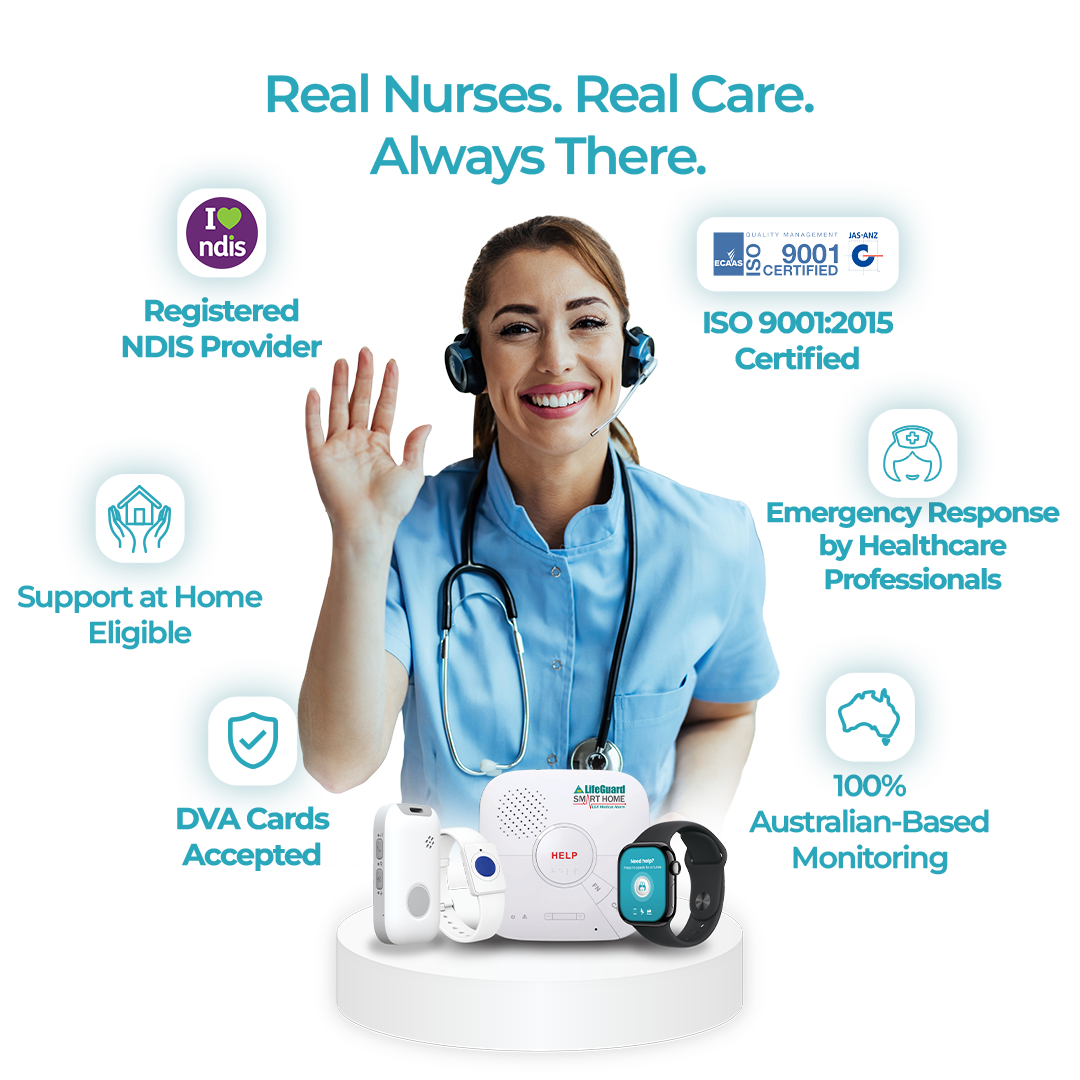
INS LifeGuard offers the only nurse-monitored personal alarms in Australia and is eligible under AT-HM, combining personal alarm technology with 24/7 monitoring by an Clinical Operations Centre staffed by trained emergency responders who are also qualified and experienced healthcare professionals, including Registered and Enrolled Nurses.
This means that when an alarm is activated, the response is not limited to receiving the alert. Our team can assess the situation, triage the incident and provide immediate medical advice where appropriate.
Eligibility for AT-HM funding is based on the individual's assessed needs and applicable Support at Home requirements, so funding is not automatic.
Learn how to get a personal alarm funded through Support at Home →
How can you find out exactly what you will pay?
To understand your likely out-of-pocket Support at Home costs, you need to know:
- which services you are approved to receive
- the contribution category for each service
- your participant contribution percentage
- your provider's agreed price for each service
- whether transitional or no worse off arrangements apply to you
Your provider should explain its service prices and your expected contribution before charging you.
Services Australia determines applicable contribution rates where an income and assets assessment is required.
You can also use the Support at Home fee estimator available through My Aged Care.
What if you can't afford your Support at Home contributions?
Financial hardship assistance may be available to eligible people who cannot afford their aged care costs because of circumstances beyond their control. The government confirms that financial hardship assistance is available for eligible Support at Home participants.
If you're struggling to meet your aged care costs, speak with your provider and contact Services Australia to find out whether financial hardship assistance may be available.
Support at Home Costs & Contributions: Frequently Asked Questions
Is Support at Home free?
Not completely. Clinical Supports have a 0% participant contribution, while contributions generally apply to Independence and Everyday Living services. What you pay depends on the service type and your financial circumstances.
Do full pensioners have to pay for Support at Home?
Under the standard arrangements, full pensioners contribute 0% towards Clinical Supports, 5% towards Independence services and 17.5% towards Everyday Living services.
Different arrangements may apply to people protected by the no worse off principle.
How much do self-funded retirees pay for Support at Home?
Under the standard arrangements, self-funded retirees without a Commonwealth Seniors Health Card contribute 0% towards Clinical Supports, 50% towards Independence services and 80% towards Everyday Living services.
Self-funded CSHC holders have means-tested contribution rates for Independence and Everyday Living services.
Do I pay if I don't use a Support at Home service?
No. Participant contributions apply to applicable services you actually receive.
Are Support at Home contributions the same as co-payments?
The Australian Government generally uses the term participant contribution. You may also hear these out-of-pocket costs described as co-payments or co-contributions.
Does my Support at Home classification determine how much I pay?
No. Your classification determines the government funding available for your assessed ongoing care needs. Your participant contribution determines what you personally contribute towards applicable services.
Is personal care free under Support at Home?
Not yet. Until 30 September 2026, personal care remains subject to the existing Independence contribution arrangements.
From 1 October 2026, eligible participants will pay no participant contribution for approved personal care services, provided they have available Support at Home funding.
Where can I check what I will have to pay?
You can use the Support at Home fee estimator through My Aged Care and speak with your provider about service prices. Services Australia determines applicable contribution rates where an income and assets assessment is required.
Understanding your Support at Home costs
Remember that your Support at Home funding and your participant contributions are not the same.
Your assessed care needs determine the funding available for your approved support. Your contribution rate, the services you actually use and the prices charged by your provider determine what you may need to pay yourself.
Understanding both can help you make informed decisions about your care and avoid unexpected costs.
For a broader explanation of Support at Home eligibility, services, funding classifications, assessments and pathways, read our complete Support at Home guide →
This article provides general information. Support at Home contribution rates, thresholds, caps and program arrangements can change. Individual costs depend on your services, financial circumstances and any transitional arrangements that apply. Check My Aged Care, Services Australia or the Australian Government Department of Health, Disability and Ageing for information that applies to your circumstances.
Related Articles

Hospital stays can be stressful, especially when transitioning home or to without the support of an aged care facility. INS LifeGuard provides essential services to help patients leave the hospital safely and confidently, ensuring needed support and ongoing care.

Breast, bowel, lung, cervical & heart health screenings are available to Australians in their 50s, most of them free. Here's what each one involves & who qualifies.

Uncover if falling asleep after meals is a warning sign for diabetes. Learn about possible symptoms, risk factors, and prevention methods.
About
INS LifeGuard is the only 24/7 nurse on-call personal and medical monitoring in Australia. We provide monitoring technology for both in the home and on the go and can also monitor other provider's equipment. Our services are suitable for anyone wanting support to stay independent such as the elderly, those with medical conditions and disabilities plus enhancing safety and security for lone workers.