
Have a Question?


Personal Alarm Maintenance for Retirement Villages: What to Check Before Something Fails
INS LifeGuard • October 14, 2026
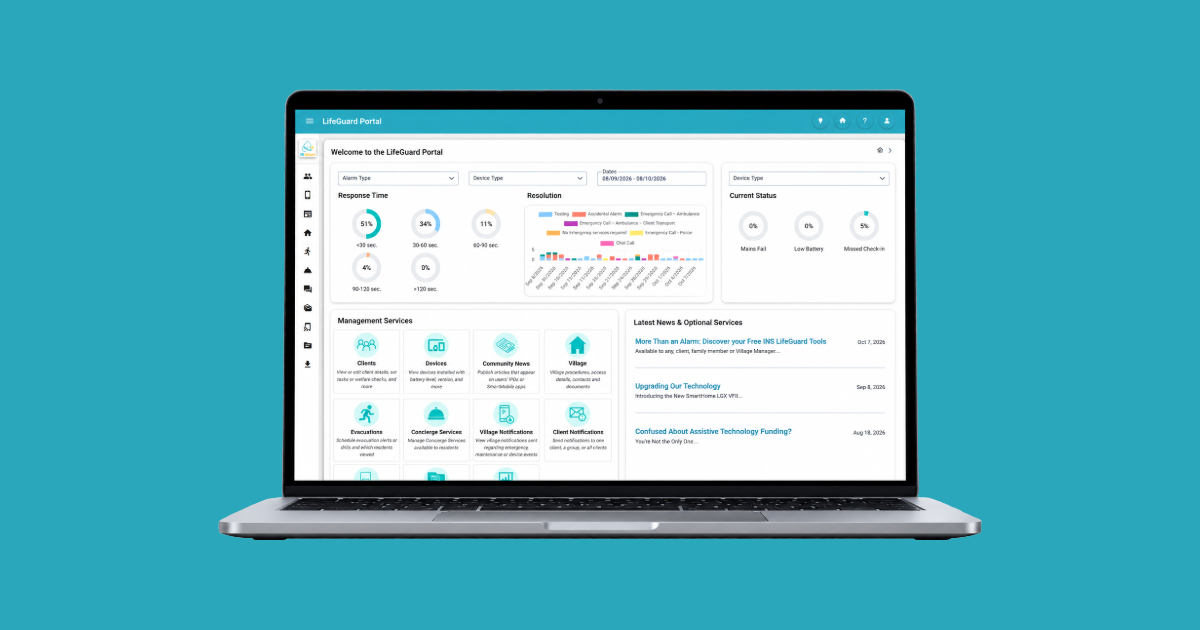
In one retirement village we looked at, 41% of personal alarm base units were more than three years old, and key-holder or access details were on file for only 27% of residents. Neither finding needed an emergency to uncover. The information was already there.
Most villages only find out a personal alarm device has a problem when someone needs it: a base unit that's been running on its backup battery for weeks, a pendant years past its review date, or a resident's key-holder details that were never added. The Village Health Check puts that information in front of you first, so you can act before it becomes an emergency.
What is a Village Health Check?
The Village Health Check is a free monthly snapshot for every INS village. It brings together four views of your village in one report, with 2024, 2025 and 2026 to date shown side by side, so you can see what's changing and act before it becomes a failure.
What to check in your village's personal alarm system
Monitoring. Every alarm INS received, what our nurses recorded, and how quickly each one was answered. You can share alarm volumes, emergency calls and answer times with your board and with families.
Devices. The age and health of every base unit, pendant, call point and smoke alarm on site. That includes base units over 3 years old, pendants and call points past their age threshold, low-battery and power-fail alarms, and devices that haven't been tested in 30 days.
Online services. How your staff use the LifeGuard Portal, measured against four best-practice checks: alerts switched on for village contacts, scheduled reports set up, and procedures and access details updated in the last 12 months.
Resident records. How complete each resident's file is: medical details, GP, key-holder and emergency contacts, and who has permission to update them.
What one village's snapshot showed
To show what the report looks like, we ran a snapshot for one INS-monitored village of about 220 residents. The operator and village have been removed and the figures rounded.
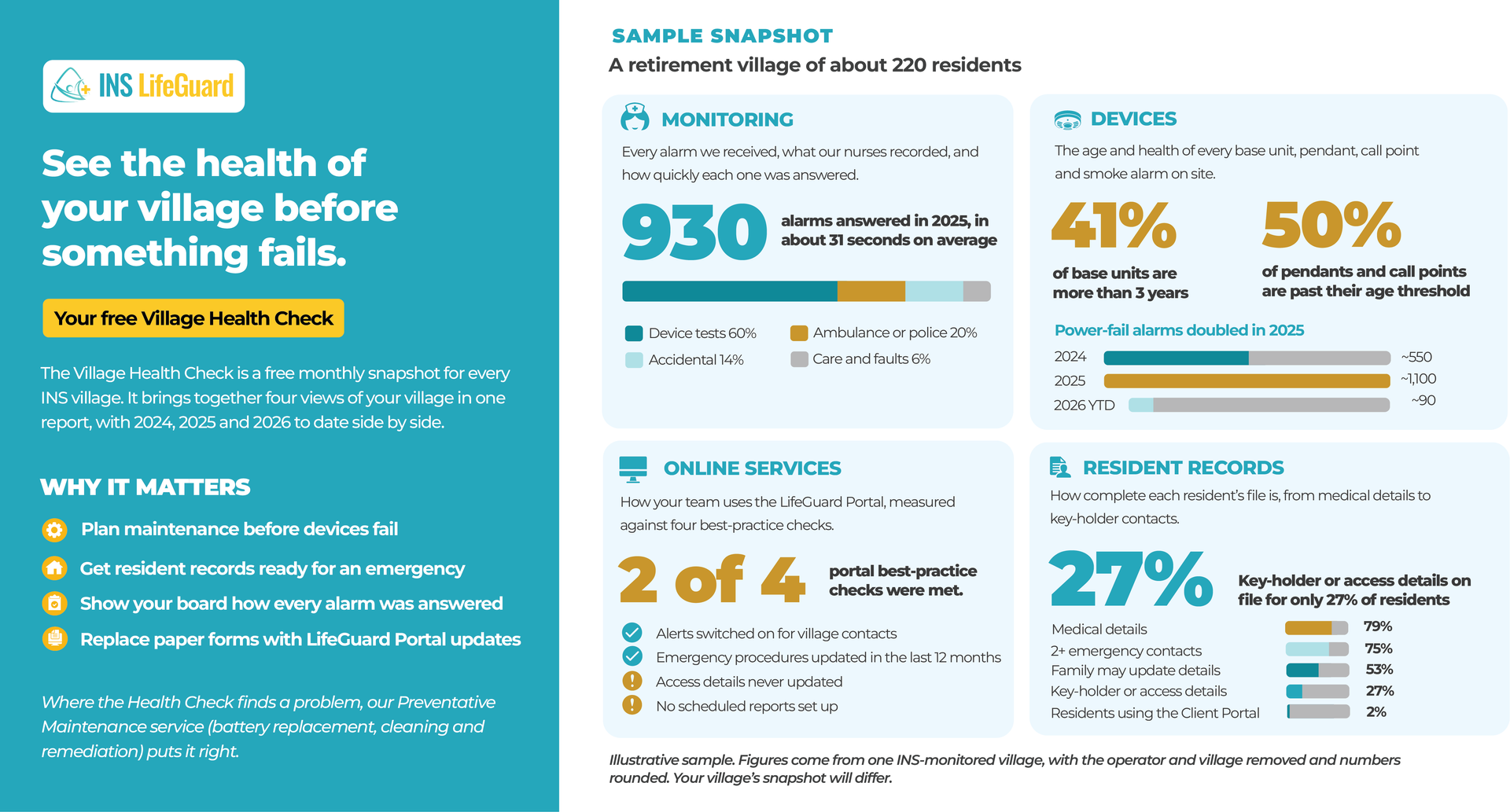
- 930 alarms answered in 2025, in about 31 seconds on average. Six in ten were residents testing their devices, which is exactly what you want to see.
- 41% of base units are more than 3 years old, and half the pendants and call points are past their age threshold.
- Power-fail alarms doubled, from about 550 in 2024 to about 1,100 in 2025. The snapshot shows a spike like this in the month it happens, not at the next audit.
- Medical details are on file for 79% of residents, but key-holder or access details for only 27%. Those are the details responders rely on to get into a home quickly in an emergency.
- 2 of 4 portal best-practice checks were met. Alerts were switched on and procedures were current, but access details had never been updated and no scheduled reports were set up.
Every village is different, so your snapshot will tell its own story.
Why device maintenance matters for your village
Retirement village legislation sets out what villages must provide for residents' safety, including emergency call systems. The equipment in your village belongs to the village, so knowing which devices are ageing, and keeping a clear history of how they're maintained, helps protect your residents and your village. Our guide to what every retirement village is legally required to provide covers those obligations in detail.
AS 4607, the Australian Standard for personal response systems, covers the alarm equipment, batteries and monitoring centre themselves. That side is our responsibility as your provider.
Planning personal alarm maintenance before devices fail
Where the Village Health Check turns up a problem, our Preventative Maintenance service puts it right, from battery replacement and cleaning to remediation of ageing devices. You can plan and budget the work in advance, instead of reacting when something fails.
As Claude Rafin, our Managing Director, says: "Sometimes the greatest achievement is the emergency that never happened." Well-maintained devices are how villages get there.
Behind every alarm, a nurse
Every alarm in the Monitoring view is answered by a nurse in our Clinical Operations Centre, and that changes what happens next. A traditional emergency response centre receives the alarm, assesses it, calls family or an ambulance, and ends the interaction. Our nurses know the person and understand their health. They monitor trends, step in to prevent deterioration, respond when necessary and support recovery, with one goal: returning each resident to ordinary life.
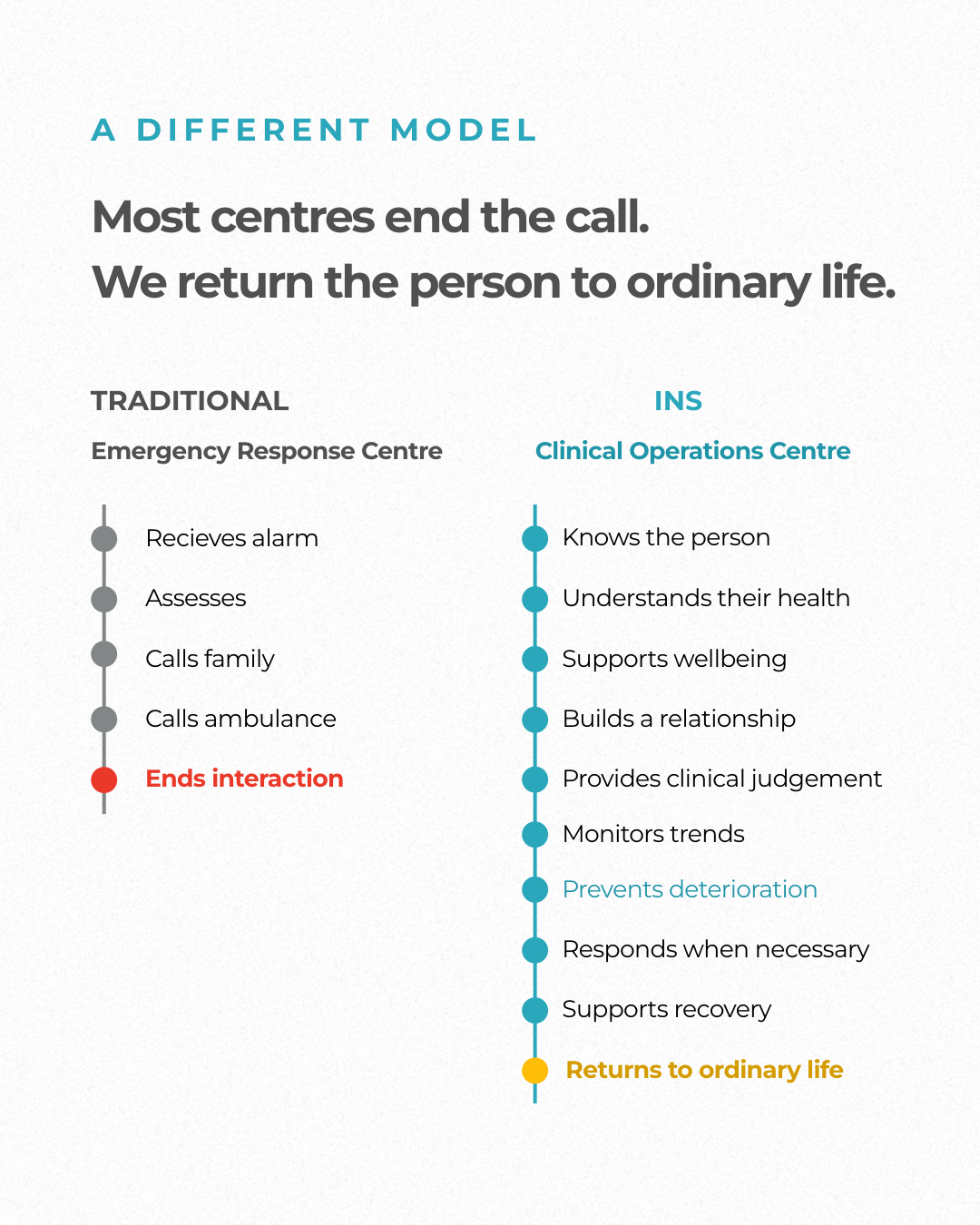
"Technology notices. Clinicians interpret. Compassion determines what happens next." Claude Rafin, Managing Director, The INS Group
Frequently asked questions
Is the Village Health Check free?
Yes. The Village Health Check is free for every village monitored by INS.
How often is the Village Health Check updated?
Monthly. Each snapshot shows 2024, 2025 and 2026 to date side by side, so you can see trends as well as this month's results.
How often should personal alarm devices be serviced?
As a guide, INS recommends servicing diallers every 3 years, replacing standard pendants every 3 to 5 years, and replacing call point batteries every 2 to 5 years. Fall sensor batteries and 9V smoke detector batteries should be replaced every year. Intervals depend on how often each device is used, and our servicing and maintenance guidelines list them for every device.
What is a power-fail alarm?
A power-fail alarm means a resident's base unit has lost mains power and is running on its backup battery. A rise in power-fail alarms can point to a wiring, power point or outage issue worth checking before the backup battery runs flat.
Why does it matter if a device hasn't been tested in 30 days?
Regular testing is how you know a pendant or call point will work when a resident needs it. The snapshot flags devices that haven't been tested in 30 days, so village staff can prompt those residents.
What does AS 4607 cover?
AS 4607 is the Australian Standard for personal response systems. It sets minimum performance, design and operating requirements for the system itself: the alarm equipment, its batteries and the monitoring centre. Those requirements sit with the provider.
See it at Village Summit 2026
Our team is at Village Summit 2026 in all five cities: Perth on 10 November, Adelaide on 12 November, Brisbane on 17 November, Melbourne on 24 November and Sydney on 26 November. Visit our stand to see a sample snapshot and the LifeGuard Portal in action.
What happens when you book
Book a 15-minute chat with our team at any Village Summit city, or a meeting with our Business Development team at any time. We'll walk you through a sample snapshot and what it shows for a village like yours. If your village is already monitored by INS, we'll arrange a snapshot of your own.
Book your free Village Health Check
Illustrative sample. Figures come from one INS-monitored village, with the operator and village removed and numbers rounded. Your village's snapshot will differ.
About
INS LifeGuard is the only 24/7 nurse on-call personal and medical monitoring in Australia. We provide monitoring technology for both in the home and on the go and can also monitor other provider's equipment. Our services are suitable for anyone wanting support to stay independent such as the elderly, those with medical conditions and disabilities plus enhancing safety and security for lone workers.