

Have a Question?

Commonwealth Seniors Health Card: Who Is Eligible, What Are the Benefits and How Do You Apply?
INS LifeGuard • October 23, 2026

Retirement should be a time to enjoy life, maintain your independence and feel confident about the future. However, with the rising cost of everyday essentials, healthcare and household expenses, knowing which government concessions are available can make a meaningful difference.
One valuable benefit some older Australians may be missing is the Commonwealth Seniors Health Card (CSHC).
If you've reached Age Pension age but don't qualify for the Age Pension, you may still be eligible for this Australian Government concession card, which can help reduce the cost of prescription medicines, certain medical services and other everyday expenses.
At INS LifeGuard, a trusted Australian provider of personal medical alarms and senior alarms, we believe staying informed about available government benefits is as important as having reliable support when you need it. Our commitment to helping older Australians live safely and independently extends beyond our 24/7 nurse-monitored personal alarm services.
That's why we've put together this comprehensive guide to the Commonwealth Seniors Health Card, covering who qualifies, the latest income limits, available benefits, how to apply and answers to the most frequently asked questions.
What Is the Commonwealth Seniors Health Card?
The Commonwealth Seniors Health Card is an Australian Government concession card that helps eligible older Australians access more affordable healthcare and other potential discounts.
It is particularly useful for self-funded retirees and people who have reached Age Pension age but do not qualify for income support payments.
Services Australia administers the card, with separate arrangements through the Department of Veterans' Affairs (DVA) for eligible veterans and their families.
Unlike the Age Pension, the Commonwealth Seniors Health Card does not provide a regular pension payment. Instead, it gives eligible cardholders access to concessions that may reduce their ongoing living expenses.
Some benefits are available nationally, while others depend on the state or territory in which you live.
Who Is Eligible for the Commonwealth Seniors Health Card?
Good to know: Being a self-funded retiree does not automatically exclude you. In fact, the card is particularly relevant to retirees who are not eligible for the Age Pension.
Quick eligibility check
You may be eligible if you can answer yes to all of these questions:
- Have I reached Age Pension age (67 for anyone born on or after 1 January 1957)?
- Do I live in Australia and meet the residence rules?
- Am I not receiving the Age Pension or another income support payment from Centrelink or DVA?
- Is my adjusted taxable income, plus any deemed income from account-based pensions, under $105,048 if I'm single, or $168,076 combined if I'm part of a couple?
- Can I provide my Tax File Number and prove my identity?
If you answered yes to every question, it's worth applying. If you're unsure about the income question, the income section below explains what counts and includes worked examples.
Who is not eligible?
You can't get the card if you:
- are under Age Pension age
- receive the Age Pension or another income support payment from Centrelink or DVA
- already hold a Pensioner Concession Card, which gives you the same health concessions and more
- have income over the limit for your situation.
Residence rules
On the day you claim, you must be an Australian resident and be in Australia. To keep the card, you must continue to live in Australia as an Australian resident or special category visa (SCV) holder.
If you've recently become an Australian resident, you may have to wait 2 or 4 years before you can get the card. Some exemptions apply, so check with Services Australia if you've moved to Australia in the last few years.
What if my partner is younger than me?
You can claim the card once you reach Age Pension age, even if your partner hasn't. Your partner's income still counts, because couples are assessed against the combined couple limit. Your partner can claim their own card once they reach Age Pension age and meet the rules.
Veterans, partners and war widows
Veterans with qualifying service, their partners, and war widows and widowers may be able to get the card through the Department of Veterans' Affairs (DVA) instead of Services Australia. The same income test applies, but age and other rules differ, so check with DVA on 1800 VETERAN (1800 838 372).
Source: Services Australia – Who can get a Commonwealth Seniors Health Card.
Commonwealth Seniors Health Card Income Limits
One of the most common questions is: How much can I earn and still qualify for the Commonwealth Seniors Health Card?
The current limits apply from 20 September 2026 (up from $101,105 for a single person and $161,768 for a couple combined).
The current annual income limits are:
| Your situation | Annual income limit |
|---|---|
| Single | $105,048 |
| Couple (combined) | $168,076 |
| Couple separated by illness, respite care or prison (combined) | $210,096 |
The threshold increases by $639.60 for each dependent child in your care.
These limits are reviewed annually, generally on 20 September, in line with the Consumer Price Index.
Is there an assets test?
No. There is no assets test for the Commonwealth Seniors Health Card.
This is an important difference between the Commonwealth Seniors Health Card and the Age Pension.
You may own your home and have savings, investments, or superannuation and still qualify, provided you meet the relevant income and other eligibility requirements.
However, certain account-based retirement income streams are subject to deeming rules. This means Services Australia may assess an assumed amount of income from these investments when determining eligibility.
Some people are exempt from deeming. If you've held a Commonwealth Seniors Health Card continuously since 31 December 2014, and you have an account-based income stream you bought before 1 January 2015, that income stream is not deemed. This is known as grandfathering. You lose it permanently if your card is cancelled, even briefly, or if you replace or change that income stream.
What income counts towards eligibility?
The income assessment considers your adjusted taxable income, your partner's income where applicable, and deemed income from relevant account-based income streams.
Adjusted taxable income can include amounts beyond ordinary taxable income, so it is important not to rely solely on your salary, bank interest or tax return total when assessing eligibility. For example, it includes reportable fringe benefits, reportable super contributions, net investment losses and foreign income.
Services Australia usually assesses your most recent taxable income from the past two years. If your income has dropped since then, for example because you've stopped work, you can provide evidence of the change.
Examples: would you meet the income test?
These simplified examples show how the income test works. Your own assessment may differ.
Example 1: Ron and Helen are both 68 and self-funded retirees. They own their home and have most of their savings in account-based pensions. Their combined adjusted taxable income is $95,000, plus $14,000 of deemed income from their account-based pensions, a total of $109,000. That is under the $168,076 couple limit, so they meet the income test.
Example 2: Margaret is 70, single and still working. Her taxable income is $98,000, which is under the $105,048 limit. But she also salary sacrifices $10,000 into super, which counts as a reportable super contribution. Her adjusted taxable income is $108,000, so she would not meet the income test this year.
Example 3: Peter is single and has held the card since 2013. His account-based pension started in 2012, so it is grandfathered and not deemed. Only his adjusted taxable income of $30,000 from part-time work and rent is assessed.
Source: Services Australia – Commonwealth Seniors Health Card income test.
What Benefits Can You Get with a Commonwealth Seniors Health Card?

The Commonwealth Seniors Health Card mainly makes essential healthcare more affordable.
Depending on your circumstances and where you live, you may also be eligible for additional concessions.
1. Cheaper prescription medicines
One of the most valuable benefits is access to cheaper eligible prescription medicines through the Pharmaceutical Benefits Scheme (PBS).
The concessional patient co-payment is generally up to $7.70 per eligible PBS prescription, although additional charges can apply in some circumstances. This amount is fixed until the end of 2029.
If you regularly take medication, this can save you money over the course of a year.
Eligible cardholders also benefit from the PBS Safety Net. Once you or your family reach the safety net threshold for the calendar year ($277.20 in 2026), further eligible PBS prescriptions are free for the rest of that year.
Source: Australian Government Pharmaceutical Benefits Scheme.
2. Potential bulk-billed GP appointments
Commonwealth Seniors Health Card holders may be able to access bulk-billed GP appointments.
Bulk billing means the medical practice bills Medicare directly for an eligible service, rather than charging you an out-of-pocket consultation fee.
However, holding the card does not guarantee bulk billing. Individual medical practices determine their billing arrangements.
It's worth asking your GP clinic whether they bulk bill Commonwealth Seniors Health Card holders.
3. Medicare Safety Net benefits
The Medicare Safety Net helps reduce out-of-pocket costs for eligible out-of-hospital medical services once you reach the relevant annual threshold.
This can be particularly helpful for older Australians who require frequent specialist appointments, diagnostic tests or other Medicare-covered services.
The Extended Medicare Safety Net threshold is lower for concession card holders, including Commonwealth Seniors Health Card holders. In 2026 it is $861.20 in out-of-pocket costs, compared with $2,699.10 for most other people, and the Original Medicare Safety Net threshold is $594.40 for everyone. Thresholds are updated on 1 January each year.
4. Electricity, gas and household concessions
Depending on where you live, your Commonwealth Seniors Health Card may help you qualify for certain state, territory or local government concessions.
These may include discounts or rebates relating to:
- Electricity and gas bills
- Water and council rates
- Public transport
- Ambulance services
- Selected healthcare services
Not every concession is available in every state, and some require additional eligibility checks or separate applications.
Important: Do not assume that presenting the card automatically activates every available discount. Contact the relevant provider to confirm the concession and application process.
Commonwealth Seniors Health Card Benefits by State and Territory
The additional concessions available to cardholders can vary considerably across Australia.
Here's what Commonwealth Seniors Health Card holders should check in each state and territory. Amounts and rules change each financial year, so confirm with the program before you apply.
| State or territory | What to check |
|---|---|
| New South Wales | CSHC holders can apply for the NSW Seniors Energy Rebate to help with electricity bills. |
| Victoria | Several Victorian energy and water concessions need a Pensioner Concession Card or Health Care Card, so check which ones list the CSHC on the Victorian Government concessions page. |
| Queensland | The Queensland Electricity Rebate does not accept the CSHC on its own, but it does accept a Queensland Seniors Card. See Queensland electricity and gas rebates. |
| South Australia | CSHC holders can access several SA concessions, including the Cost of Living Concession and the energy concession. See the SA concession finder for CSHC holders. |
| Western Australia | CSHC holders may be eligible for the Energy Assistance Payment. If your electricity isn't with Synergy or Horizon Power, apply through the Energy Concession Extension Scheme. Otherwise, ask your retailer. |
| Tasmania | Use the Service Tasmania concessions guide to see which concessions accept the CSHC, or call Service Tasmania on 1300 13 55 13. |
| Australian Capital Territory | The ACT Utilities Concession does not accept the CSHC. Check other ACT concessions with ACT Revenue Office. |
| Northern Territory | The NT Concession Scheme lists the CSHC as a qualifying card, subject to NT residence rules. Check the NT Concession Scheme eligibility page. |
When checking eligibility, look specifically for concessions that accept the Commonwealth Seniors Health Card, rather than only a Pensioner Concession Card or state Seniors Card.
These cards are different and are not interchangeable for every benefit.
How to Apply for a Commonwealth Seniors Health Card
Applying is generally straightforward, particularly if you already have a myGov account linked to Centrelink.
Step 1: Check your eligibility
Use the quick eligibility check above to confirm you've reached Age Pension age and meet the residence and income rules.
Step 2: Prepare your information
You may need information about your identity, Tax File Number, income, partner's circumstances and relevant retirement income streams.
Step 3: Sign in to myGov
Visit myGov and sign in to your account.
If you haven't linked Centrelink to your myGov account, you may need to do this first.
Step 4: Start your claim
Access Centrelink through myGov and follow the instructions to claim a Commonwealth Seniors Health Card.
Step 5: Provide any requested documents
Services Australia may request supporting information to assess your eligibility.
Step 6: Wait for the outcome
You can track your claim online. If approved, your card can be made available digitally through the Express Plus Centrelink app, and a physical card will also be posted to you.
If you cannot apply online, Services Australia offers alternative options, including applying by form or contacting the Older Australians line on 132 300.
Source: How to claim a Commonwealth Seniors Health Card.
Commonwealth Seniors Health Card vs Pensioner Concession Card vs Seniors Card
These three cards are often confused, but they serve different purposes.
| Card | Main purpose |
|---|---|
| Commonwealth Seniors Health Card | Healthcare concessions for eligible older Australians who are not receiving specified income support payments |
| Pensioner Concession Card | Concessions for eligible pension and certain other income support recipients |
| State or Territory Seniors Card | Discounts and benefits offered through state or territory seniors programs, generally subject to age, residence and work requirements |
A person may qualify for a state Seniors Card as well as a Commonwealth Seniors Health Card, provided they meet the separate requirements.
Note that the state and territory Seniors Cards are separate from the Commonwealth Seniors Health Card. They are issued by state and territory governments, often from age 60, and mainly offer discounts on things like transport and shopping rather than health concessions. Eligibility rules differ between states and territories, so check with your local government.
What About the Companion Card in Australia?
Another valuable program worth knowing about is the Companion Card, which helps eligible Australians with significant and permanent disabilities participate more easily in community activities.
Unlike the Commonwealth Seniors Health Card, which provides healthcare concessions to eligible older Australians, the Companion Card is designed for people who require lifelong attendant care support to participate in community activities and events.
The Companion Card allows an eligible cardholder to bring a support person or carer to participating venues, attractions and events without paying an additional admission fee for their companion.
Can seniors apply for a Companion Card?
Yes. Older Australians may qualify for a Companion Card if they meet the relevant disability and attendant care eligibility criteria. However, age alone does not determine eligibility.
The Companion Card is administered through state and territory programs, so application processes and eligibility requirements may vary depending on where you live.
If you or someone you care for needs ongoing assistance to enjoy activities outside the home, it's worth exploring whether this program could help.
Want to learn more? Read our comprehensive guide on how to apply for the Companion Card in Australia, including eligibility information and the application process.
Frequently Asked Questions About the Commonwealth Seniors Health Card
Can self-funded retirees get the Commonwealth Seniors Health Card?
Yes. Self-funded retirees may qualify if they have reached Age Pension age and meet the income, residence and other eligibility requirements.
Can I get the card if I own my home?
Yes. Home ownership does not automatically affect eligibility because there is no assets test.
However, income generated by investments and certain retirement income streams can be relevant.
Does superannuation affect eligibility?
It can. Certain account-based superannuation income streams are assessed using deeming rules. The treatment depends on the type of income stream and relevant circumstances.
Check the official income test before applying.
Can I work and still receive the card?
Potentially, yes. Employment does not automatically exclude you, but your assessed income must remain within the applicable limit.
If you return to work or your income changes, you must notify Services Australia as required.
Is the Commonwealth Seniors Health Card free?
Yes. There is no application fee to claim the card through Services Australia.
Does the card expire?
Yes. Your card has an expiry date.
If you still qualify, Services Australia will normally post you a new card before your current one expires.
What happens if my income changes?
You must notify Services Australia of relevant changes to your circumstances, generally within 14 days.
A change in income could affect your eligibility.
Can I use my Commonwealth Seniors Health Card when travelling?
The card may be useful when accessing eligible concessions within Australia, although individual concession rules vary.
Overseas travel can affect how long your card remains current. Check Services Australia's travel rules before leaving Australia.
Can I get the Commonwealth Seniors Health Card if I receive the Age Pension?
Generally, no. Age Pension recipients typically qualify for a Pensioner Concession Card instead.
Is the Seniors Card the same as the Seniors Health Card?
No. They are two different cards. The Commonwealth Seniors Health Card is an Australian Government card that gives eligible people access to health concessions, and it has an income test. A state or territory Seniors Card is issued by your state or territory government and mainly offers discounts and, in some states, public transport concessions.
In NSW, for example, you can apply for a NSW Seniors Card if you are aged 60 or over (or turning 60 within three weeks), live in NSW, are an Australian citizen or permanent resident, and work 20 hours a week or less on average over 12 months. If you work more than that, you may be eligible for the NSW Senior Savers Card instead, which includes discounts but not public transport concessions. Both NSW cards are free, and you can hold either of them alongside a Commonwealth Seniors Health Card. Check the current rules with Service NSW.
Does the Commonwealth Seniors Health Card pay for personal alarms?
The Commonwealth Seniors Health Card does not automatically provide government funding for personal alarms.
Personal alarms are not a standard national benefit of the card.
However, eligible older Australians may be able to explore personal alarm assistance through other pathways, such as government-funded aged care programs or Department of Veterans' Affairs arrangements, depending on individual eligibility, assessments and program rules. Our guide to getting a government-funded personal alarm explains the main pathways, including Support at Home, CHSP, NDIS and DVA.
It is important to check these separately rather than assuming the Commonwealth Seniors Health Card covers the cost.
Independence Is About More Than Managing Costs
Managing healthcare costs is only one part of enjoying a safe, comfortable and independent retirement.
For many older Australians, feeling confident at home and when out in the community is equally important.
Whether you live alone, enjoy regular walks, travel independently or have family members who worry about your wellbeing, having access to help in an emergency can provide valuable reassurance.
This is where a monitored personal alarm may be worth considering.
How INS LifeGuard Supports Independent Living
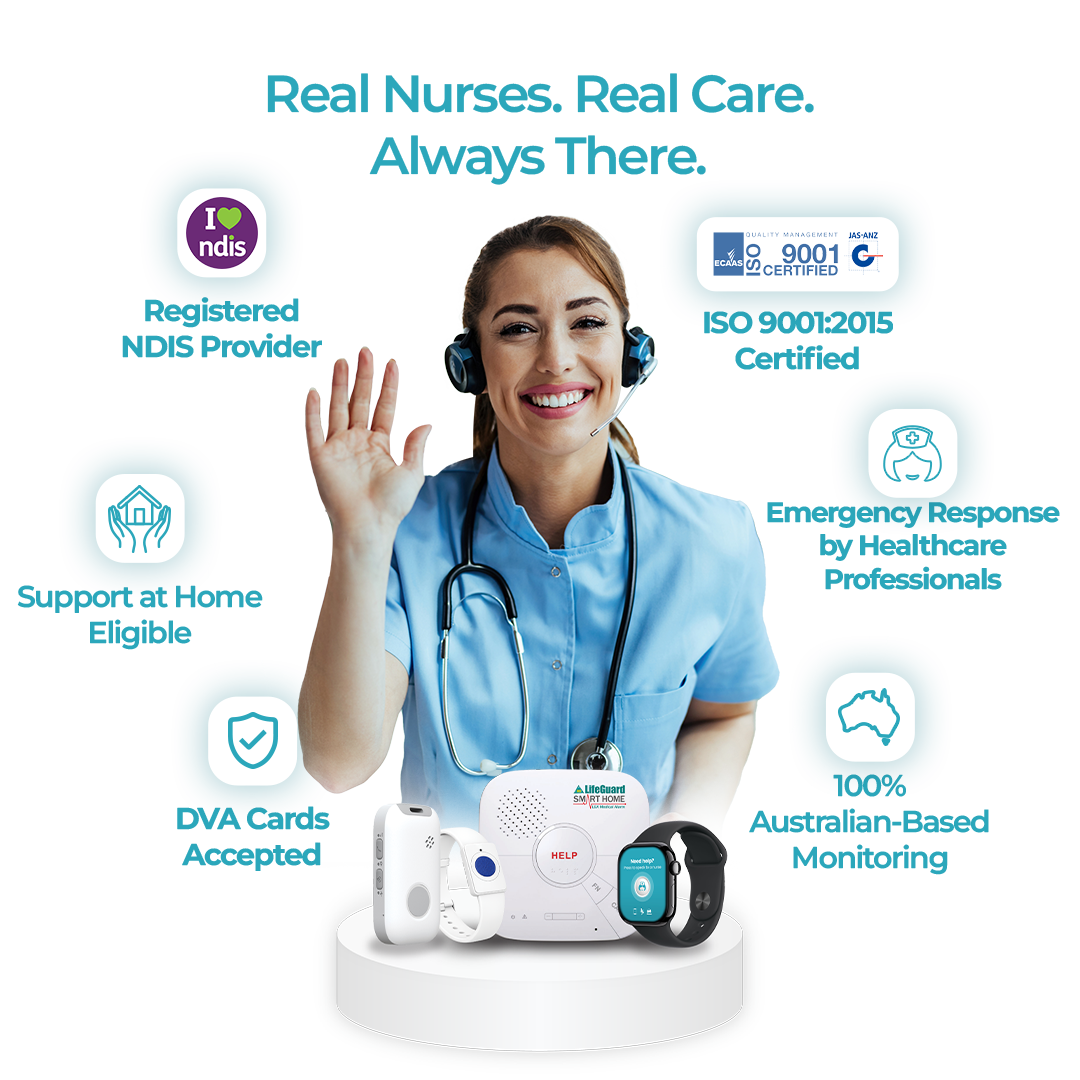
INS LifeGuard provides monitored personal alarm and medical alert solutions designed to help older Australians remain safe and independent at home and while out in the community.
INS LifeGuard stands out for its 24/7 nurse-led emergency response service.
When an INS LifeGuard personal alarm is activated, the user connects with an Australian-based Clinical Operations Centre staffed by trained responders, including Registered and Enrolled Nurses and other qualified healthcare professionals.
Depending on the situation, the team can assess the concern, provide reassurance, notify nominated contacts or coordinate emergency assistance.
Depending on the selected device, features may include:
- An emergency help button
- Two-way voice communication
- GPS location support
- Automatic fall detection
- Mobile and smartwatch personal alarm options
- 24/7 monitored emergency response
For seniors who want to remain active and independent, these solutions can offer an additional layer of support.
Explore INS LifeGuard's monitored personal alarms for seniors to learn more about the available options.
Final Thoughts: Is the Commonwealth Seniors Health Card Worth Applying For?
For eligible older Australians, the Commonwealth Seniors Health Card is well worth investigating.
Even if you don't qualify for the Age Pension, you may still be entitled to valuable healthcare concessions that help make everyday expenses more manageable.
The key points to remember are:
- You must generally have reached Age Pension age.
- There is an income test, but no assets test.
- Eligible cardholders can access cheaper PBS medicines and other potential healthcare benefits.
- Additional concessions vary by state and territory.
- Applications can be made through Services Australia.
- Eligibility and concession rules can change, so checking official government information is essential.
Taking advantage of available concessions is one way to make retirement more affordable. Planning for your safety and wellbeing is another.
At INS LifeGuard, we believe older Australians should have the confidence to enjoy life on their own terms, knowing support is available when they need it.
Want extra peace of mind at home or on the go?
Discover how INS LifeGuard's 24/7 nurse-monitored personal alarms can help support safer, more independent living.
You can also call 1800 636 226 to speak with the INS LifeGuard team.
Official Government Resources and Further Reading
For the most accurate and up-to-date information, we recommend these official sources:
- Services Australia – Commonwealth Seniors Health Card
- Services Australia – Eligibility requirements
- Services Australia – Income limits and assessment
- Services Australia – Benefits and concessions
- Services Australia – How to apply
- Services Australia – Renewing and replacing your card
- Department of Veterans' Affairs – Commonwealth Seniors Health Card
- Pharmaceutical Benefits Scheme
Disclaimer: This article provides general information only and does not constitute financial, legal or government benefits advice. Eligibility, income thresholds, concessions and funding arrangements may change. Always confirm your circumstances and current entitlements with Services Australia or the relevant government authority.
Last reviewed: 23 October 2026.
About
INS LifeGuard is the only 24/7 nurse on-call personal and medical monitoring in Australia. We provide monitoring technology for both in the home and on the go and can also monitor other provider's equipment. Our services are suitable for anyone wanting support to stay independent such as the elderly, those with medical conditions and disabilities plus enhancing safety and security for lone workers.